

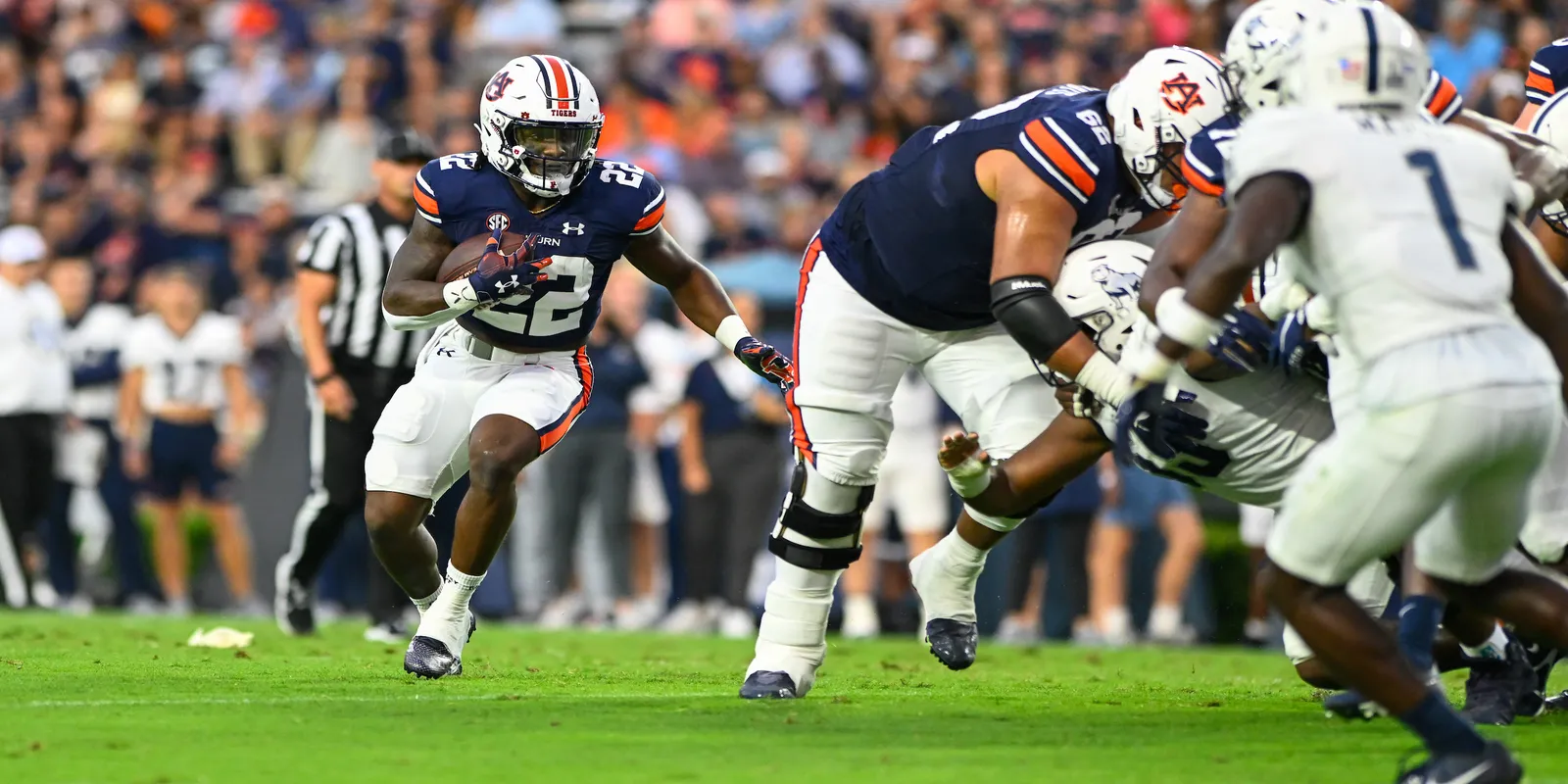
In 2025, Auburn football faces a familiar mandate: run the damn ball. The program’s storied success has always depended on a dominant rushing attack, and the latest data reveals just how far the Tigers strayed from that formula. This season, a return to physical, ground-and-pound football could be the key to reviving Auburn’s offensive identity.
Auburn’s Rushing Identity Is Key
Auburn’s rich history includes powerhouse rushing seasons, with only three campaigns since 2008 falling short of 2,000 rushing yards. All three of those seasons — 2008, 2012, and 2023 — were followed by major coaching shake-ups or significant underperformance. Auburn finished with just 1,986 rushing yards in 2023, the lowest since 2012. With advanced stats showing an average of 5.42 yards per carry on third and short, the problem clearly wasn’t talent or execution — it was play-calling.

Run the Damn Ball Mentality
The four-word keyphrase “Run the Damn Ball” is more than a slogan — it’s a strategy. Auburn averaged nearly 5 yards per carry in 2023, yet only logged 404 rushing attempts. That’s fewer than many SEC competitors, even with a more efficient rushing game. Quarterback Jackson Arnold enters the scene in 2025 as a mobile option who can stretch defenses and complement Auburn’s deep backfield.
Players like Damari Alston, Jeremiah Cobb, and Alvin Henderson offer depth and versatility. If Auburn distributes carries effectively, it could easily push past 2,900 yards, potentially leading the SEC in total rushing.

Balanced Offense Wins Games
While the push to run the ball dominates the conversation, balance remains essential. Auburn’s 2023 passing attack tallied 3,167 yards at an impressive 8.6 yards per attempt — ranking them in the conference’s upper tier. However, the lack of balance meant predictable play-calling and missed scoring opportunities. Jackson Arnold has the tools to hit 200+ yards per game through the air, especially with targets like Cam Coleman, Perry Thompson, and Malcolm Simmons.
Historical Benchmarks Show the Way
In 2016, Auburn amassed 3,500 rushing yards. Though that wasn’t a championship year, the physical dominance on the ground created competitive advantages. By contrast, 2023’s output reflected a program unsure of its identity. To return to form, Auburn needs a ground game that punishes defenses and sets up the play-action pass. Only Tennessee, with 2,936 rushing yards, eclipsed what Auburn could achieve with a more consistent commitment to running.
Coaching and Accountability in 2025
Last season’s 5-7 record belies Auburn’s top-seven SEC standing in both rushing and passing stats. The issue wasn’t talent — it was situational coaching and inconsistent offensive identity. With DJ Durkin anchoring the defense and Hugh Freeze doubling down on recruiting elite skill players, 2025 offers no excuses. It’s put-up-or-shut-up time for Auburn’s coaching staff.
Hugh Freeze passed on elite transfer quarterbacks like Cam Ward, choosing instead to invest across the roster. The result is a stacked offense that now needs strategic cohesion. The four-word keyphrase “Run the Damn Ball” sums up the urgency — Auburn can no longer afford to ignore its historical formula for success.
Conclusion: Run The Damn Ball
Auburn’s 2025 campaign must prioritize running the ball as a foundational element of offensive success. With a deep, talented backfield and a mobile quarterback, the Tigers are positioned to eclipse past rushing totals and dominate the SEC’s physical style of play. If balance is achieved with Auburn’s improved wide receiver corps, a breakout season is not only possible — it’s expected.
📌 Related Article:
The Importance of Play Calling Consistency in SEC Offenses