


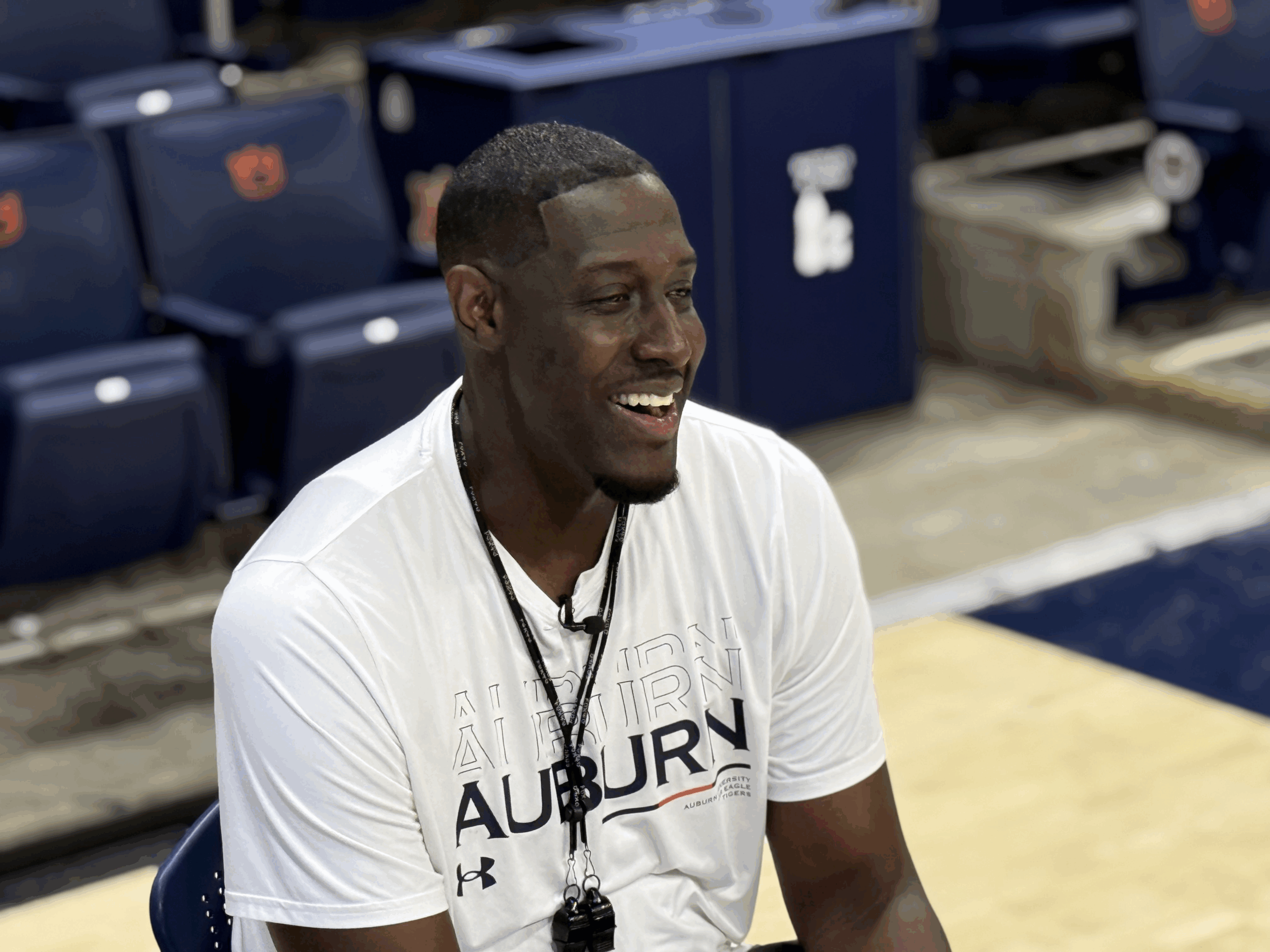
Auburn women’s basketball head coach Larry Vickers has completed his ninth week on the job. He is settling into life in the Deep South. A native of Norfolk, Virginia, Vickers admits that adjusting to the slower pace of Auburn, Alabama, has brought change. The smaller population of Auburn has also presented opportunities.
For the first time in years, Vickers finds himself navigating a new town without needing GPS around his own home. “I’m still figuring out how to get to the mall,” he said, laughing. These days, most of his free time is spent grabbing lunch at Hay Day with his staff and focusing on building the basketball program.
Understanding the culture of Auburn quickly became a top priority. That process began with his staffing decisions. He leaned on institutional knowledge by hiring Auburn alumna AK Prestridge and former assistant Caroline McCombs, both of whom bring familiarity with the university and region. He also added Rodney Hill and Candice Jackson, along with several support staffers retained from the previous regime, including Reneisha Bolden, Daquan Gordon as video coordinator, and Connor Putnam in graphics.
The team Vickers has assembled on the court reflects his desire for balance. With a mix of freshmen, sophomores, and a core of experienced veterans, he believes Auburn will be competitive in the SEC. That core includes Mya Petticord, a Rutgers transfer; A’riel Jackson, a double-digit scorer at Cincinnati; and returning guard Kaitlyn Duhon, who has battled injuries but brings SEC experience and leadership.

Vickers sees opportunity in players like Sania Richardson and Harrisoum Coulibaly —both top 100 recruits—who arrive with a touch more polish from the start. “They’re just a tad better, so hopefully they’ll be able to make some of those reads immediately,” he said. His goal is to pair that skill with basketball IQ and help players reach their potential through teaching and development.
That development-first mindset is what got Vickers into coaching. Reflecting on his time as a 208-pound forward at Norfolk State, he described how physical mismatches led him to rely on finesse. When his coach’s system didn’t fit his style, a pivot came. Instead of continuing as a player, he became one of the youngest assistant coaches in the country. “All I wanted to do was develop players—from NBA to WNBA to college, high school, middle school,” he said. “Just help them get better.”
His coaching roots also include a unique start in women’s basketball. At Norfolk State, he finished the season as the interim women’s coach while still serving on the men’s staff, going back and forth between practices and games. “Anytime you’re doing double duty, it’s time-consuming,” Vickers said. “But the administration knew I was a hard worker.”
That work ethic is already visible in Auburn. While rebuilding the program, Vickers is instilling identity. Unlike coaches who target elite performance in one or two areas, he’s building a well-rounded team. “I want to be a B in everything,” he said. The goal is a team that can win in different ways and make life hard for opponents.
On the court, Vickers is bringing his trademark defensive versatility from Norfolk State—press zones, man-to-man schemes, and different wrinkles. Offensively, he’s installing a five-out system with options to transition into continuity or more traditional actions. Adaptability is the theme.
Developing bigs is another focus. Arek Angui, a 6-foot-8 redshirt sophomore with a pro-level skill set, is still learning to apply those tools in crowded game situations. “You see her workout and think she’s a pro,” Vickers said, “but now it’s about playing through contact and double teams.” The staff is also working closely with Quanirah Montague, a Mississippi State transfer who played behind one of the nation’s best centers. “She’s not DeYona Gaston,” he said, “but like Dee, we expect a big jump now that she’ll play more minutes.”
As for rotation philosophy, Vickers isn’t married to a specific number. Instead, it’s about who can retain concepts, run the system, and contribute to a style that coaches and fans alike can appreciate. “We want to be your favorite coach’s favorite team to watch.”
He’s also navigating new terrain in college athletics—NIL, transfer portal, and now the House settlement. “It’s like buying your first home during the housing bubble,” he said. “You’re bidding at asking price, and someone else is offering ten times more.” With few clear rules, the support of Auburn’s administration has been key. Vickers credits John Cohen, Mary McLendon, and Robert Carlisle for helping him learn the ropes. “They’re here every day. That’s important.”
Having Cohen, a former coach himself, in the AD chair has been a plus. “He understands the ups and downs, and he wants to win,” Vickers said. “Even when we sign players, he’s looking at the tape. He’s invested.”
Vickers isn’t overwhelmed by the rebuild—he’s done it before. At Norfolk State, he inherited a winless team and turned it into a championship program. At Auburn, he’s taking the same steady, system-first approach. “Love the game, and the improvement will follow.”
With the roster set, the foundation forming, and the install phase underway, the journey is just beginning.